Mission 01
Humanity Founders Hub
Shipped production Flutter apps end to end — authentication, REST integrations, performance tuning and real production debugging across Android & iOS.
BuiltFlutterFirebaseREST APIsIn-app purchases

AI Product Engineer
Most AI demos impress.
Production systems survive.
I build the second.
Shipped to app stores and production — not demos.

“The hardest, most human part isn't writing the code.
It's deciding what to build, and being right.”
Don't take my word for it — query the record. Pick a Studio Record or ask anything; every answer shows its reasoning and the sources behind it.
Start a conversation →Tools change every six months. Judgment compounds. This is the loop I run on every product.
Start from what hurts and who feels it — never from the model.
Is AI even the right tool here? Most ideas die at this question.
Design the system around the model: boundaries, fallbacks, guardrails.
Decide what to make swappable and what to harden. Buy future speed now.
Direct AI for the volume; own the calls. Days, not months.
Watch real usage. Keep what earns its place; cut the rest.
One night, shipping a fix the team needed by morning.
Production bug. A few users locked out.
Traced it to a race condition in the sync layer.
Redesigned how state reconciles — cleaner, safer.
Tests green. Edge cases covered.
Deploy complete. Logs quiet.
The team logs in. It just works. Nobody knows.
The opinionated stuff — what I rejected, what broke, and what I'd do again.
A clever prompt is a demo. The engineering is the system around it — fallbacks, daily budgets, guardrails, a kill switch. That's what survives contact with real users.
For ApplySync I chose Firebase over Postgres. It cut deploy from days to hours and kept the early build simple. Postgres would have doubled the complexity for value I didn't need yet — and I can migrate later if scale demands it.
ApplySync worked end to end and launched to almost zero users. The lesson reorganized how I build: shipping isn't the finish line, it's the start of the real problem — getting people to use it.
For I Am Still Alive I assume the model will sometimes be wrong. So: de-identify before any call, audit every request, cap usage, and keep one switch that halts all AI instantly. Safety over uptime.
On the conference platform every model sits behind a single interface. When a better/cheaper model appears, it's a one-line swap — not a refactor across 35 data models.
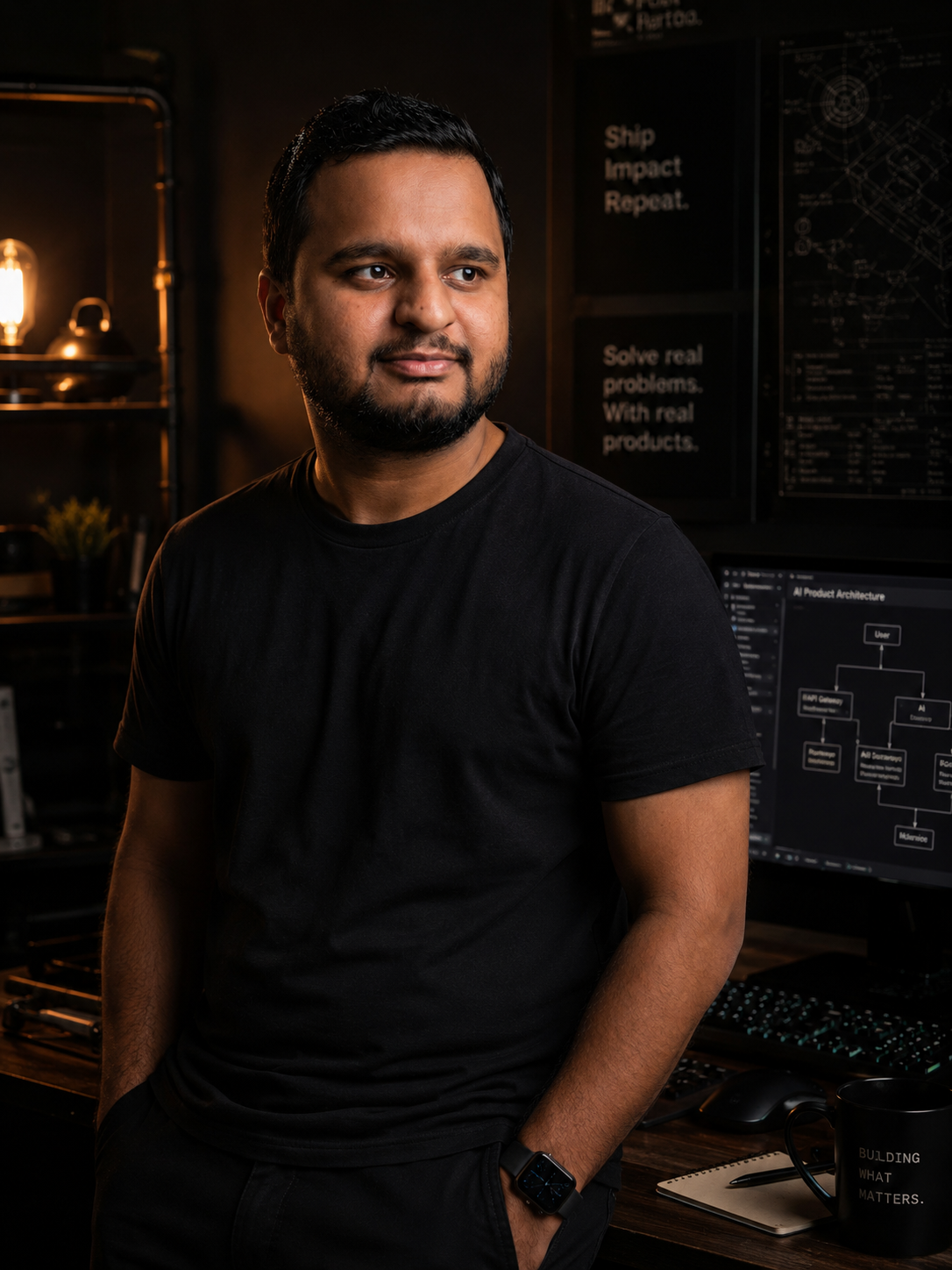
I care about systems that work. I care about users who trust them. I care about impact that compounds. I'm an AI-native builder from Chalisgaon, Maharashtra — I design the architecture, direct the AI, and own the outcome end to end.
Learned by building — apps, full-stack, the hard way.
Real systems: healthcare AI, events, internal tools.
6 products shipped by directing AI end to end.
Building systems people rely on, from Chalisgaon, Maharashtra.
Not a résumé — a path. What I built, in order.
Three teams. Three roles. What I actually shipped.
Shipped production Flutter apps end to end — authentication, REST integrations, performance tuning and real production debugging across Android & iOS.
Owned architecture and product decisions on an oncology-support platform, with AI-assisted development — working directly with CEO Danielle Bellini.
An AI SaaS that discovers jobs, rewrites résumés per ATS, applies through Gmail and auto-fills forms via a Chrome extension — designed and built solo, front to back.
Not a badge wall — the capabilities behind the products.
Interfaces people actually use.
APIs, data, auth, real-time.
Systems around the model — not just prompts.
Ship it and keep it running.
Turning a demo into a product.
Milestones, open source, and what I'm building right now.